Saint Kolbe's white and red roses

St Maximilian Kolbe is a saint in modern times - he experienced both the First and Second World Wars.
Kolbe was born on 8 January 1894 as Raymond Kolbe in a low-income family with a German father and a Polish mother in Wola, a then Russian-occupied area. He developed his faith from a young age and recalled his vision of asking Mother Mary what was to become of him. Mother Mary asked him to choose between a white rose and a red rose - the former is for purity, while the latter is for martyrdom; and he said he would accept them both. And he did as his life experience unfolded.
He was enrolled on the Conventual Franciscan Seminary at the age of 13, together with his brother. He took his vow as a monk in 1914, with the religious name Maximilian. He subsequently studied in Warsaw, Rome and Krakow and was ordained a priest in 1919 in the newly independent Poland. He was actively working for the conversion of sinners and enemies of the Church. He felt especially strong for Mother Mary and has been active with Militia Immaculata, through publications and radio broadcasts, sharing his faith.
Kolbe in Nagasaki, Japan
In 1930, Kolbe went to Japan as a missionary and set up a monastery in Nagasaki. The friary was located behind a mountain, as Mary had told Kolbe, despite the Franciscans’ concern that it was too far from the people. It proved to be the right choice subsequently, as it survived the atomic bomb dropped on 9 August 1945 by the United States, three days after the first atomic bomb was dropped in Hiroshima.
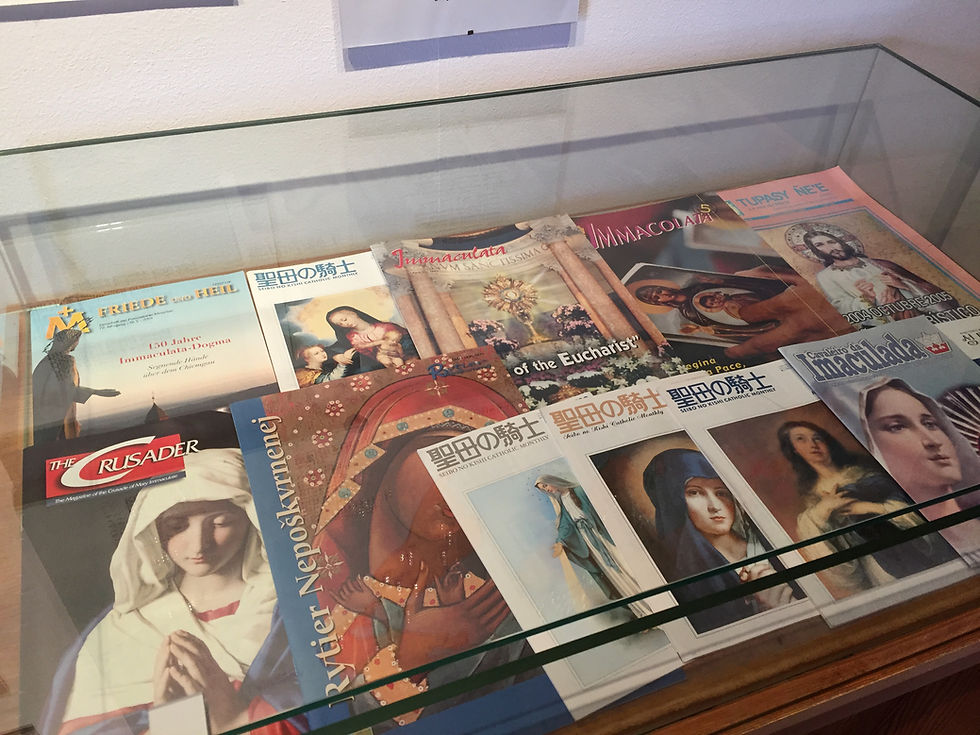
During Kolbe’s six years in Japan, he actively promoted the Catholic Faith, established the Garden of Mary with a Lourdes Grotto, and continued to publish the magazine Knights of the Immaculate (Seibo no Kishi) in Japan. The House continues to be used by seminarians but has also set up a St Kolbe Museum with his artefacts and relics. Pope John Paul II also visited the Monastery in 1981 during his visit to Japan.
Kolbe in Auschwitz and Martyrdom
Kolbe had to leave Japan in 1936 primarily because of his tuberculosis and deteriorating health. He continued to be active in publishing and evangelisation while back in Niepokalanów, his primary Polish Monastery. In 1941, Kolbe was arrested when the Gestapo closed his operation in support of the Jews. He was sent to the Auschwitz camp with the number 16670. He volunteered to take the place of another prisoner for a punishment and was martyred on 14 August 1941.

Canonisation and Pilgrimage
He was canonised by Pope John Paul II in 1982. Today, in Poland, a St Kolbe Museum is located in the St. Francis Monastery in Niepokalanów. (https://rycerzniepokalanej.pl/niepokalanow-prezentuje-muzeum-sw-maksymiliana/) The St Kolbe museum and the Garden of Mary in Ngagsaki are also open for pilgrims and visitors. (https://www.japan.travel/en/ph/church/kyushu/nagasaki-area-churches/)

Comments